Tuesday, July 6, 2010

La Iglesia de Cuba "esperanzada" con la visita de Moratinos

«La visita reafirma la esperanza acerca de los prisioneros y Cuba en el contexto mundial», señaló el cardenal arzobispo de La Habana

7 de Julio del 2010
El cardenal Jaime Ortega, arzobispo de La Habana, aseguró hoy que la visita a Cuba del ministro español de Asuntos Exteriores, Miguel Ángel Moratinos, "reafirma la esperanza" sobre la situación de los presos políticos en la isla. "Se reafirma con su visita (en referencia al ministro español) la esperanza que ya hemos anunciado anteriormente acerca de estos temas de los prisioneros y de todo lo que tenga que ver con un avance en la presencia de Cuba en el contexto mundial positivamente considerado", señaló Ortega.


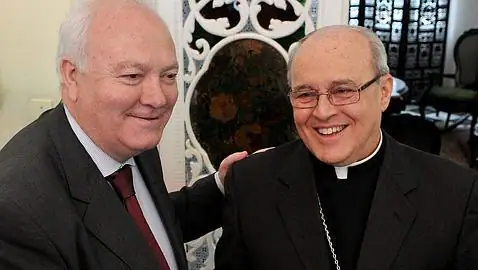
Moratinos con el cardenal arzobispo de la Habana

El cardenal hizo estas declaraciones a periodistas tras reunirse en el Arzobispado de La Habana con el ministro español, que se encuentra en Cuba para apoyar el diálogo abierto entre la Iglesia católica y el Gobierno de Raúl Castro sobre los presos políticos. Jaime Ortega agradeció al ministro español su postura de "comunicación y puente" con Cuba, así como su esfuerzo para tratar de normalizar las relaciones con la Unión Europea, regidas desde 1996 por la llamada "posición común", que las condiciona a avances en materia de derechos humanos. "Se lo agradezco como cubano, como arzobispo de La Habana y como miembro de esta Iglesia que ha tenido esta oportunidad especial de llevar adelante un momento muy propicio para poder dar algunos pasos positivos en el mejor sentido de nuestra situación nacional", declaró el religioso. Por su parte, Moratinos manifestó que el Gobierno español se siente "muy satisfecho" de la labor de la Iglesia cubana en su diálogo con las autoridades de la isla. "Esperamos lógicamente que ese trabajo dé resultados", dijo el jefe de la diplomacia española, quien garantizó que el Gobierno de España "está acompañando todas las actividades y actuaciones del cardenal Ortega y la Iglesia Católica". Tras su encuentro con Ortega, que duró cerca de una hora y media, el ministro español eludió pronunciarse sobre la posibilidad de que España acoja a presos políticos cubanos en el caso de que se produzcan excarcelaciones, al ser preguntado por la prensa. "Vamos a seguir trabajando, vamos a seguir dialogando y eso es lo que tenemos que hacer", manifestó. La visita de Moratinos a Cuba ha aumentado las expectativas de que el Gobierno del general Raúl Castro libere a presos políticos, en el marco del proceso de diálogo abierto con la jerarquía católica el pasado mes de mayo. Fruto de esas conversaciones, el régimen cubano excarceló en junio a un preso gravemente enfermo, Ariel Sigler, y "acercó" a doce a centros penitenciarios ubicados en sus provincias de residencia. Además de con Ortega, el jefe de la diplomacia española se reunió este martes con el canciller cubano, Bruno Rodríguez, con quien repasó el estado de las relaciones bilaterales entre ambos países. Ambos coincidieron en que el momento de esta visita -la tercera de Moratinos a Cuba- se produce en un momento "importante" y "promisorio" y se mostraron convencidos del éxito de la misma.

Moratinos espera obtener gestos hacia los presos en Cuba que cambien la política de la UE

El ministro de Exteriores confía en la derogación de la Posición Común que condiciona desde 1996 el diálogo europeo con La Habana

M. VICENT / M. GONZÁLEZ | La Habana

6 de Julio del 2010

El Pais

Nunca una visita del ministro de Asuntos Exteriores, Miguel Ángel Moratinos, había levantado tanta expectación como la que inició el lunes por la noche a La Habana. La pregunta no es si se producirá una liberación de presos políticos, algo que casi todo el mundo da por descontado, sino qué alcance tendrá y si se hará coincidir su anuncio con la presencia del jefe de la diplomacia española, que en la noche del miércoles regresa a Madrid.

Moratinos ha dado a entender que no se marchará con las manos vacías al declarar, al inicio de la reunión que las dos delegaciones han mantenido este martes por la tarde en la sede de la cancillería cubana, su convencimiento de que la visita será un éxito y, lo que es más importante, que así lo considerarán también los otros socios de la UE. Su objetivo explícito es la derogación de la llamada Posición Común, que condiciona desde 1996 el diálogo europeo con La Habana al respeto a los derechos humanos y los avances democráticos. El ministro español ha conseguido que sus colegas de la UE le den una prórroga de dos meses, hasta septiembre, para obtener gestos significativos por parte de las autoridades cubanas. Pero sabe que los partidarios de la firmeza -encabezados por Alemania, República Checa o Polonia- se negarán en redondo a cualquier concesión si no se produce antes la liberación de un grupo significativo de los 167 prisioneros políticos que hay en la isla. No bastan las excarcelaciones a cuentagotas y los traslados penitenciarios realizados hasta ahora. El propio canciller cubano, Bruno Rodríguez, ha reconocido los "esfuerzos" realizados por la presidencia española de la UE para derogar la Posición Común, que ha tachado de "injusta, injerencista y discriminatoria", y se ha mostrado convencido de que la visita de Moratinos, "en un momento promisorio", no sólo será un éxito desde el punto de vista bilateral sino que también tendrá también efectos para las relaciones entre Cuba y la UE. Un guiño dentro de la calculada ambigüedad que rodea esta visita. Rodríguez acudió el lunes por la noche a recibir al ministro español al aeropuerto José Martí y luego le acompañó a la residencia oficial del embajador español en La Habana, Manuel Cacho, como muestra de la complicidad que se ha generado entre ambos. El tercer actor de este drama, cuyos hilos se tejen entre bambalinas, es el cardenal Jaime Ortega, con quien Moratinos ha departido durante hora y media este martes en el Arzobispado de La Habana. "Apoyamos las gestiones de la Iglesia cubana y esperamos que ese trabajo dé resultados", declaró el ministro tras la entrevista. "Se reafirma con su visita [del jefe de la diplomacia española] la esperanza acerca de los prisioneros" políticos, añadió el cardenal, quien agregó que el actual momento es "muy propicio para que se puedan dar algunos pasos positivos". Un lenguaje cauteloso que apenas disimula el temor a que pudiera malograrse en el último momento la esperada liberación de presos políticos. Uno de los elementos que más preocupan es el la situación del disidente Guillermo Fariñas, que se encuentra en estado crítico tras más de 130 días de huelga de hambre y sed en demanda de la liberación de 25 reclusos de conciencia que se encuentran enfermos. La delegación que acompaña al ministro ha estado permanentemente pendiente de su estado de salud, pues un desenlace trágico de su protesta podría hacer descarrilar o como mínimo retrasar, toda la operación. Por su parte, el presidente de la Comisión Cubana de Derechos Humanos y Reconciliación Nacional (CCDHRN), Elizardo Sánchez, ha informado de que unos 40 presos políticos han sido entrevistados o sometidos a chequeos médicos en las cárceles en los últimos días, un hecho que en su opinión podría indicar que se prepara una excarcelación masiva. La última palabra la tiene el presidente Raúl Castro, con quien Moratinos tiene previsto reunirse antes de regresar a Madrid, a pesar de que la cita no figura en el programa oficial.

Dissident on hunger strike in danger of dying, Cuba says

Los Angeles Times
July 6, 2010

A prominent Cuban dissident on a hunger strike has developed a blood clot that could kill him, Cuba's government said in an unprecedented official report in the Communist Party state-run newspaper. Here's the report in state-run Granma, in Spanish, headlined "Fighting for life is our responsibility." (The English version of the site does not appear to have the article posted.) In the report, a doctor who has been treating Guillermo Farinas said the dissident is fed nutrients intravenously and has gained weight since being admitted to the Arnaldo Milian Castro University Hospital in the city of Santa Clara. But infections and a recent clot that could block the flow of blood to his heart is putting Farinas's life in danger, Dr. Armando Caballero said. The Granma story fills two pages in the eight-page newspaper but does not mention that Farinas is on a hunger strike to demand the release of political prisoners in Cuba. The 48-year-old psychologist and journalist began the hunger strike Feb. 24; he was moved March 11 to the Milian Castro hospital, where he has access to a telephone line and a television. The dissident has carried out 22 hunger strikes in the last 15 years, reports said. He has vowed to remain on hunger strike until all political prisoners and dissidents in Cuba are released. Cuba usually ignores calls to release dissidents but has faced increased international pressure and protests on the island from the "ladies in white." The movement of mothers and wives of jailed dissidents grew after the February death of another hunger-striker, Orlando Zapata. Late last month the Cuban government released one dissident, Darsi Ferrer. Ferrer had been jailed for 11 months for allegedly buying black-market cement. Critics said his punishment was excessive. "The entire Cuban population buys black-market goods," economist Oscar Espinosa Chepe said.

-- Daniel Hernandez in Mexico City

Spain's FM in Cuba as hunger-striker nears death


By Rigoberto Diaz
HAVANA (Agence France Press)

July 5, 2010 — Spain's top diplomat rushed to Havana in a bid to save the life of a hunger-striker who is defying the communist government and demanding that sick political prisoners be freed. In Madrid, Spain's leading daily El Pais said Foreign Minister Miguel Angel Moratinos, who arrived in Cuba late Monday, believes the communist government will gradually begin releasing all political prisoners, starting with 26 who are in poor health, as a result of his visit. Releasing the sick, jailed dissidents would meet the top demand of seriously ill hunger-striking Cuban activist Guillermo Farinas, a psychologist and online journalist who has put his life on the line in a high-stakes clash with the Americas' only one-party Communist regime. In unprecedented coverage of a dissident's protest, the Communist Party daily Granma reported Saturday Farinas could soon die -- without mentioning his hunger strike seeking freedom for jailed dissidents has left him near death. Farinas, 48, hit back against Cuban government authoritarianism and repression in a statement released on an opposition blog Monday, complaining sarcastically: "they forgot to explain why it is I am on a hunger strike." In any case, "the only people who will be responsible for my death are brothers (former president) Fidel and (President) Raul Castro," Farinas said. "I want to die in my country right under the noses of the dictators who have the guns, rifles, cannons and bombs. I have the moral weight of the people from below, who have been deceived and repressed for 51 years by those who have the weapons, the violence and totalitarian laws they use to govern poorly from above," Farinas added. Moratinos is to hold talks with his Cuban counterpart, Bruno Rodriguez, and the archbishop of Havana, Jaime Ortega. But a meeting with Cuban President Raul Castro "is not yet confirmed," the Spanish foreign ministry has said. The visit comes after Havana said at the weekend that dissident Farinas is close to death after 132 days on a hunger strike.

While Moratinos is not scheduled to meet with Farinas, the Spanish diplomat told a news conference Monday that his delegation would be in touch with the dissident's entourage "and will express our conviction that the best thing for everyone would be for him to end this hunger strike. "We think that (Farinas) should already feel satisfied with his aims and that he should work, as we are all doing, to improve human rights in Cuba," he said. "I obviously have other objectives on this visit to Cuba which make it worthwhile and can lead to results and help all the citizens of Cuba," he said. Farinas stopped taking food the day after leading dissident Orlando Zapata died on February 23 as the result of an 85-day hunger strike. The international outcry over both hunger strikes and pressures from the Catholic Church led the Castro regime last month to free a paraplegic dissident and transfer 12 other prisoners to jails closer to their homes. The Cuban Human Rights and National Reconciliation Commission (CCDHRN) -- an outlawed but tolerated group -- estimates there are 167 political prisoners in the Caribbean nation of more than 11 million people. The group's leader, Elizardo Sanchez, said "there is a high likelihood" Havana will set free 30-40 political prisoners in coming "days or weeks." "There are a lot of signs inside the prisons, They are getting medical checkups and being asked in prison if they want to leave the country," Sanchez said. Spanish media have reported France and Italy would take released prisoners, but officials believe most would depart for the United States. Chile also has said it would take in some of those freed. Cuban authorities consider the dissidents a threat to national security, and claim the prisoners are "mercenaries" on Washington's pay, out to smear the Cuban government.

Drilling off Cuba could be sticky proposition


By Christine Stapleton


The Seattle Times (Cox Newspapers)


WEST PALM BEACH, Fla. — Despite the warnings of Dick Cheney, George Will, Rush Limbaugh and Fox News, the Russians are not drilling for oil off Cuba. Neither are the Chinese. In fact, no one — not even Cuba — is drilling for oil off Cuba. The pesky and persistent rumor, bubbling back up with the Deepwater Horizon disaster, is still nothing more than a pesky and persistent rumor — aired in 2008 by former Vice President Cheney (who got the misinformation from conservative columnist Will), repeated on Fox News and recently revived by conservative radio commentator Limbaugh, who told his listeners 10 days after the spill: "The Russians are drilling in a deal with the Cubans in the Gulf. The Vietnamese and Angola are drilling for oil in the Gulf in deals with the Cubans. "However, as oil from BP's exploded well continues surging from the Gulf floor and washing onto Panhandle beaches, the rumor is poised to become fact. Repsol, a Spanish company, expects to begin drilling off Cuba in 2011, according to published reports and oil-industry analysts. Companies from at least 10 other countries, including Russia and China, are negotiating or already have signed lease deals to drill off Cuba. Should the United States be concerned about drilling off Cuba? Yes, according to Jorge Piñon, former president of Amoco Oil Latin America and now a visiting research fellow with the Cuban Research Institute at Florida International University. "Let's face it, the oil industry is a risky enterprise and there is always concern for a Deepwater Horizon incident," Piñon said. But he added: "If we are going to be afraid of drilling off Cuba, we need to be afraid of the 3,500 rigs drilling in the Gulf of Mexico. "How much oil lies beneath Cuban waters is unknown. Only one exploration well has been dug and hydrocarbons were detected. A U.S. Geological Association survey indicated there are significant reserves. The troubling question for companies hoping to drill is what to do with the oil after they get it out of the ground. Cuba has limited ability to refine oil. The embargo bans U.S. companies from refining Cuba's oil, and two other large refineries in the Caribbean are owned by U.S. companies: Hess in St. Croix, Virgin Islands, and Valero in Aruba. Venezuela's refineries are "maxed out," Piñon said. "Oil has zero value unless you can turn it into gasoline or diesel," Piñon said. "Where are they going to refine it?"


Politics could force an answer to that question. Lifting the embargo and allowing U.S. companies to profit from refining Cuban oil is one option. Another is to continue the embargo and risk Cuba strengthening its friendships with U.S. foes. A refinery on Cuba's northern coast is being built by a partnership between Venezuela and Cuba. "People say they (Cuba) can't or shouldn't do it (drill for oil). Well, forget it," Jones said. "It is going to happen, and you guys in Florida can't stop it, and the U.S. government can't stop it, but you'd better think of a way to deal with it." Zones established by maritime law in 1977 gave the United States and Cuba special rights of exploration and navigation in the Florida Straits.


The boundary of Cuba's Exclusive Economic Zone extends to within 45 miles of Key West. The parcels within the zone that Cuba has leased for drilling are along Cuba's northwest coast — about 65 miles south of Key West. By comparison, the Deepwater Horizon well, as much of a concern as it is to South Florida officials, is 800 miles away. Oil from a spill off Cuba could much more quickly enter the Florida Straits and blanket the Keys and South Florida as it is pulled north on the Gulf Stream. "It's ironic that we have been worried about them drilling when it is us that we had to worry about," said Kirby Jones, president of Alamar Associates, a consulting firm specializing in trade with Cuba. The Deepwater Horizon disaster has forced politicians, policy makers and petroleum companies to rethink how an oil spill off Cuba would play out, Jones said.


Politics, geography and long-standing grudges would make responding to a spill from Cuba much more complex. The 48-year-old Cold War era embargo against Cuba would bar U.S. companies from providing equipment, technology, advice, vessels or personnel to stop and clean a spill off Cuba. "Today, if Mexico or the Bahamas or Canada have a spill, all they have to do is call Houston and in a matter of hours they have access to submarines, skimmers and blowout preventers," Piñon said. "With Cuba, that is not the case. "Wayne Smith, a former chief of the U.S. Interests Section in Havana — the equivalent of ambassador — recently traveled to Cuba with a group of lawmakers from Texas to discuss hurricane preparedness. Conversations quickly turned to the oil spill. With oil from U.S. waters heading toward Cuba and Cuba poised to begin offshore drilling, now would be a good time for the United States to rethink its relations with Cuba and the embargo, Smith said. "Certainly you could make arrangements and exceptions to the embargo," Smith said. "Cuba seems to have the same effect on American administrations as the moon used to have on werewolves."

Can the internet bring change to Cuba?

Daniel Wilkinson
The New York Review of Books
July 6, 2010


Cuban blogger Reinaldo Escobar (center) and other dissidents, being harrassed by pro-government supporters during a protest march, Havana, November 20, 2009

For decades, the Castro government has been very effective in repressing dissent in Cuba by, among other things, preventing its critics from publishing or broadcasting their views on the island. Yet in recent years the blogosphere has created an outlet for a new kind of political criticism that is harder to control. Can it make a difference?

There are more than 100 unauthorized bloggers in Cuba, including at least two dozen that are openly critical of the government. The best-known blog, Generation Y, gets more than a million visitors a month and is translated into 18 languages. Its author, thirty-four-year-old Yoani Sánchez, has won major journalism awards in the US and Europe and in 2008 Time Magazine named her one of the world’s 100 most influential people. Sánchez has set up a “blogger academy” in her apartment, and she helped found the Web site, Voces Cubanas, which hosts the work of thirty independent bloggers.

Like other government critics, these bloggers face reprisals. Last November, for example, Sánchez reported being detained and beaten by Cuban security agents. Weeks later, her husband and fellow blogger, Reinaldo Escobar, was subject to an “act of repudiation” by an angry mob of government supporters on a Havana street. Such public harassment, as Nik Steinberg and I reported in our recent New York Review piece is commonly used against “dissidents” on the island, along with police surveillance, loss of employment, and restrictions on travel. (The Cuban government requires its citizens to obtain permission to leave the island, and those marked as “counterrevolutionaries” are generally denied it.) And then there is the perennial fear of the “knock on the door”—as Sánchez puts it—announcing the beginning of an ordeal that has been endured by countless critics: arrest, a sham trial, and years of “re-education” in prison. Cuba has more journalists locked up than any other country in the world, except China and Iran.

Policing the Internet, however, is not so easy. The Cuban government controls the island’s Internet servers, just as it controls the printing presses and broadcasting transmitters. But the inherent porousness of the Web means that anyone with an Internet connection can disseminate new material without prior approval. The government can block the sites it does not like (as it blocks Generation Y in Cuba, for instance), but it cannot stop other sites from springing up to replace them.

The biggest challenge for Cuban bloggers isn’t outright censorship. It’s simply finding a way to get online. To set up a private connection requires permission from the government, which is rarely granted. Public access is available only in a few government-run cybercafés and tourist hotels, where it costs approximately five US dollars an hour, or one-third of monthly wage of an average Cuban. As a result, bloggers often write their posts on home computers, save them on memory sticks, and pass them to friends who have Internet access and can upload them—for example workers in hotels and government offices. Others dictate their posts by phone to friends abroad, who then upload them through servers off the island.

No amount of resourcefulness, however, can change the fact that most people in Cuba are unable to access even the unblocked blogs. Indeed, the bloggers themselves are not always able to read their posts online. Some have never even seen their own sites.

Still, by reaching large audiences abroad, the critical blogs pose a threat to the Cuban government’s international image—which explains why the government and its supporters have reacted so virulently, attempting to discredit the bloggers as pawns or even paid mercenaries in the service of US imperialism. Granma, the official state news organ, published an article in its international edition dismissing Generation Y as “an example of media manipulation and interference in the internal affairs of a sovereign nation.” The editor of the pro-government blog Cubadebate, put it this way: “the United States has been waging economic and political warfare against [Cuba] for the past 50 years. And this is just the latest form of that warfare.”

Yoani Sánchez herself, when asked by another blogger about the “external factors” that had contributed to Generation Y’s popularity, acknowledged that attention by The Wall Street Journal and other foreign publications had helped bring new visitors to her site. “But,” she went on, “what happened was the readers came and they stayed. Users could have come once and not come back. Press coverage doesn’t make a site.”

So why do the readers come back?

I asked the Cuban novelist José Manuel Prieto what the bloggers’ appeal was for Cuban exiles like himself. “First, it’s their moderation,” he said. “They criticize the Cuban government without calling for its overthrow.” Indeed, Sánchez, Escobar, and others are unequivocal in their condemnation of the US embargo toward Cuba, a position that until recently was taboo within much of the exile community. In late May, for example, a group of Cubans, including Sanchez, Escobar, and several other bloggers from Voces Cubanas, signed a public letter to the US Congress, urging support for a bill to lift travel restrictions to Cuba.

But more than their politics, Prieto said, what’s appealing is their measured tone. Sánchez herself puts it this way: “I have never used verbal violence in my writings. I have not insulted or attacked anyone, never used an incendiary adjective, and that restraint may have garnered the attention and sympathy of many people.” Ironically, the bloggers’ moderation may be their most subversive quality. It makes it harder for the Castro government and its supporters to dismiss them as right-wing ideologues.

If these blogs are to serve as a catalyst for change, however, it will not be by influencing Castro sympathizers, who are less likely to read them anyway. Instead it will be their growing audience within the exile community, whose leaders have largely shaped US policy toward Cuba. Like the Cuban leaders, the anti-Castro hardliners have sought to discredit opposing views by questioning the motives and allegiances of those who hold them. They accuse critics of the US embargo of ignoring the Castros’ repressive policies. But this charge does not work with the independent bloggers in Cuba who question US policy. For not only are these writers themselves victims of the repression, they are today among its most credible witnesses.

Whether the bloggers can ultimately influence US policy is an open question. In any case, their objectives appear to be more modest—and more profound. They are not polemicists or pundits so much as poets and storytellers. They are less concerned with proposing new policies than chronicling the costs to ordinary people of the repressive policies already in place. The bloggers’ ability to evoke the realities of daily life in Cuba, Prieto says, is another principal source of their appeal.

Here is Sánchez describing one of Havana’s many sex workers:

With a tight sweater and gel-smeared hair, he offers his body for only twenty convertible pesos a night. His face, with its high cheekbones and slanted eyes, is common among those from the East of the country. He constantly moves his arms, a mixture of lasciviousness and innocence that at times provokes pity, at others desire. He is a part of the vast group of Cubans who earn a living from the sweat of their pelvis, who market their sex to foreigners and locals. An industry of quick love, of brief caresses, that has grown considerably on this Island in the last twenty years.

Here she recounts the daily chore of getting water:

I still remember how annoyed my grandmother was when I told her I couldn’t take it anymore, having to use the bathroom when there was nothing to flush with. Then we had to pull up the bucket on a rope from the floor below, helped by a pulley installed years before on the balcony. This up-and-down ritual has continued to multiply until it has become standard practice for thousands of families. In their busy daily routine they set aside time to look for water, load it and carry it, knowing that they cannot trust what comes out of the taps.

Another blogger, the forty-year-old novelist, Ángel Santiesteban, records the struggle over scarce bread outside a bakery:

When the bread comes out of the oven, the mobilization starts, disorganized shoving…. Everyone shouts, offended if someone tries to join an acquaintance in the line or tries to sneak into a possible gap with the objective of cutting in; but the violators don’t listen, the insults don’t matter, hunger is worse than shame, and they keep on pushing.


Claudia Cadelo, the twenty-seven-year-old author of the blog Octavo Cerco, begins a post with this account:

I met him when I was eighteen: intelligent, tall, good looking, mulatto, bilingual and a liar. He said he was an Arab and that was a lie, he told me he had traveled and that was a lie, he told me he had a “yuma” girlfriend who was going to get him out of the country, and that too was a lie. But I liked him anyway, I like dreamers. We became friends.

Then life took us on two different paths: I got tired of waiting for a way to leave the country [after having been refused permission to do so]; while he chose the infinite wait. Once or twice a year we see each other, every time we are further apart: I deeply enmeshed in the thick of things, he waiting and waiting.

The post then takes us up to the present. The friend, now fifty, is still waiting, his old lies exposed, his charm long gone.

He is not alone, the “infinite waiting” has claimed almost all of my friends—the petition, visa, permit to leave, permit to live abroad, permit to travel or scholarship—everyone is waiting for that paper that will take them far away, very far from The Land of No-Time…I have come to define it as a physical and spiritual state: you haven’t gone, but you are not here.

Sánchez tells the story of a man who made his living repairing damaged books. One day the man opened a large volume that had been sent for restoration and discovered inside a “detailed inventory of all the reports that the employees of a company had made against their colleagues.” It was, Sánchez writes, a “testimony, on paper, of betrayals.”

As in the plot of Dangerous Liaisons, in one part it could be read that Alberto, the chief of personnel, had been accused of taking raw material for his house. A few pages later it was the denounced himself who was relaying the “counterrevolutionary” expressions used by the cleaning assistant in the dining room. The murmurs overlapped, producing a real and abominable spectacle in which everyone spied on everyone. Maricusa, the accountant—as witnessed by her office mate—was selling cigars at retail from her desk, but when she wasn’t involved in this illegal work she turned her attention to reporting that the administrator left some hours before closing. The mechanic appeared several times, mentioned for having extramarital relations with a woman in the union, while several reports against the cook were signed in his own hand.

Some of the most telling posts probe the bloggers’ own reactions to the limits the government has placed on their freedoms. In one, Sánchez describes how she was unable to obtain copies of her own book, a compilation of her blog postings published in Chile, which she had hoped to distribute among her friends on the island. Instead, she received a note from the customs office explaining that the shipment of books had been confiscated on the grounds that the “content goes against the general interests of the nation.” In the post, she imagines what might have gone through the minds of the agents who confiscated the books and concludes:

If three years of publishing in cyberspace would serve to bring my voice only to these grim censors, I would have sufficient reason to be satisfied. Something of me would remain inside them, Just as their repressive presence has marked my blog, pushing it to leap toward freedom.

Here Cadelo reflects on her failed effort to obtain a visa to travel abroad:

Today I look at my refusal of permission to travel and it gives me peace: I was not hurt, not surprised. It is the long line that I have been drawing of my path, it’s the certainty that I wasn’t wrong, it’s the proof that the Cuban government has taken the trouble to tell me so I will know—despite the Party and its State, the security forces and their impunity—that I have managed to live as a free woman.

The paradoxical satisfaction both bloggers describe reflects a sense of vindication: The government’s confiscation of Sanchez’s book and denial of a visa for Cadelo confirms their work—not only the truth of what they write but the fact that, in the government’s own estimation, their blogs matter.

Yet there appears to be something even more basic here: the satisfaction of discerning the value of things as perhaps only someone who is deprived of them can. To a large extent this is what these blogs are: chronicles of deprivation. What appears to affect these bloggers most acutely is being deprived of ways to discuss and disagree about their country’s problems. When they manage to initiate such debate—even if it takes place in a forum that is inaccessible to most Cubans—their enthusiasm is palpable.


The bloggers of Voces Cubanas. Many Cubans are unable to access their own blogs.

Here is Sanchez’s answer to the question of why readers of her blog keep coming back:

[T]hey feel that Generation Y is a public place or a neighborhood where they can sit and talk or argue with a friend. And they have stayed there, right up to today. In this very moment my blog is alive, while I am sitting here, talking to you. People are recounting, narrating, publishing, and that is the most important kind of wealth there is.

Indeed, the posts on Generation Y routinely elicit thousands of comments from readers, most of them abroad. Some are angry diatribes. Some display the familiar intolerance of ideologues insisting on adherence to their beliefs. Most, however, are from people eager to contribute their own observations and commentary—and their own stories and vignettes—to this new “public place.” This open dialogue is a historic achievement for Cuba, and it is only possible thanks to the Internet. Yet the bloggers themselves have only limited access to this conversation, and most other Cubans on the island still have none.

One of the more moving passages I’ve come across in Generation Y over the past few months follows an interview with a Spanish journalist. Here is Sánchez, one of the world’s more influential bloggers, describing what appears to be her first encounter with the iPhone earlier this year. The passage conveys the playfulness and yearning that make her voice of moderation so appealing:

Between the walls of this house, which had heard dozens of Cubans talk of the Internet as if it were a mythical and difficult-to-reach place, this little technological gadget gave us a piece of cyberspace. We, who throughout the Blogger Academy, work on a local server that simulates the web, were suddenly able to feel the kilobytes run across the palms of our hands. I had the desperate desire to grab [the Spanish journalist’s] iPhone and run off with it to hide in my room and surf all the sites blocked on the national networks. For a second, I wanted to keep it so I could enter my own blog, which is still censored in the hotels and cybercafés. But I returned it, a bit disconsolate I confess.

For a while on that Monday, the little flag on the door of my apartment asking for “Internet for Everyone” did not seem so unrealistic.

July 6, 2010 2:15 p.m.
Wednesday, June 30, 2010

Entrevistas a Dr. Darsi Ferrer y a Juan Juan Almeida

Entrevistas a Dr. Darsi Ferrer y a Juan Juan Almeida

Cuba - Telecoms, Mobile and Broadband

Paul Budde
Communication Pty Ltd., March 2010,
Table of Contents

The Cuba - Telecoms, Mobile, and Broadband profiles the fixed-line, mobile and broadband markets in Cuba. Cuba still has the lowest mobile phone penetration in Latin America, one of the lowest levels of Internet penetration, and is among the five lowest in terms of fixed-line teledensity. Cubas fixed-line services remain a monopoly in the hands of government-controlled Empresa de Telecomunicaciones de Cuba SA (Etecsa), while mobile services are provided exclusively by Cubacel, a subsidiary of Etecsa.There remains substantial state control over the right to own and use certain communications services, including the right to access the Internet. The Obama administration has recently relaxed some of the embargo rules pertaining to telecommunications, in an attempt to improve freedom of communication and information for Cubans. Despite this, and although Raul Castro is more reform-minded than was his brother Fidel, the genuine liberalisation of Cubas telecommunications sector is expected to occur slowly over the next five to ten years.Market Highlights:In mid-2009 the Obama administration issued new policies in relation to US-Cuban relations, half of which related to the telecommunications sector. The steps were prefaced by a statement from the Obama administration saying it aimed to promote the freer flow of information to the Cuban people.For instance, the Obama administration said it would forthwith authorise US telecoms companies to establish themselves in Cuba, whether that be by way of establishing telecommunications facilities, roaming agreements with Cuban service providers, or transactions leading to the provision of satellite radio and television services. The US administration would also allow US residents to enter into service agreements with telecoms companies providing services to Cubans, as well as allowing the donation of certain telecommunications devices to Cuba without a licence.By early 2010 it was still unclear whether the Cuban government would approve of the US policy steps.In October 2009 the US government gave permission to a small Miami-based company called TeleCuba Communications to lay the first fibre-optic cable connecting the USA and Cuba. The project, which in early 2010 was still awaiting approval by the Cuban government, would cost around $18 million, financed by private investors, and would result in an 8Tb/s-10Tb/s capacity cable which could be operational by mid-2011. In addition to the US initiatives, stimulus for reform may also be aided by recently improved bilateral relations with Russia. In March 2010 Cuba and Russian signed a telecommunications pact in which the two countries agreed to jointly develop information technology. As part of the pact, delegates from both countries would also evaluate other possibilities for cooperation in the areas of radio spectrum, telecommunications and professional training.In the meantime, the substantial gap between Cubas mobile penetration, which stands at around 6% as at early 2010, and the rest of Latin Americas, which averages above 80%, continues to widen.Data in this report is the latest available at the time of preparation and may not be for the current year.

Wednesday, June 23, 2010

Cuba sets free Darsi Ferrer in Havana

Taken from "beforerumors.com" from June 23, 2010 post

The Cuban prisoner Darsi Ferrer is already released. After spending 11 months on remand and numerous protests by his situation, so yesterday was tried by a court in Havana, coinciding with the unprecedented process of open dialogue between the Cuban Catholic Church and the government of Raul Castro, now has allowed the release of political prisoner Ariel Sigler Amaya. Ferrer was arrested in 2009 for an alleged crime of illegal purchase of construction materials, and prosecutors asked for him three years in prison for “receiving” and “bombing.” The court sentenced him to 15 months, but allowed him to perform on his home the four remaining months of sanction under the regime of “probation.”
The dialogue between the Church and the regime has helped release. “It was the predictable,” he said yesterday human rights activist Elizardo Sanchez. For him, the release of Ferrer “deals” with the process of dialogue between the Church and the Government, even though his case is different from that of prisoners of conscience from the Group of 75. “The current line of the government is leaving the problem of prisoners,” he says, after stating that there will be “more prisoner releases and movements” in the coming weeks. Ferrer is a doctor, is 40 and began military opposition a decade ago. He became known for its street actions, especially the marches organized in a central park in Havana 10 December to mark the World Day of Human Rights. For his opposition activities was arrested on numerous occasions, but the arrests were always short. It was only the July 21, 2009. That day he was detained and questioned about the provenance of some building materials seized in a pre-registration at home. Ferrer was charged with receiving, for having “illegally acquired” two bags of cement, aluminum windows and several plates of iron which would reform the home. In addition, the office was accused of an attack by an alleged physical assault on a person in your neighborhood. During the 11 months he spent in prison, Ferrer made several protests and hunger strikes to demand that his trial. In early 2010, Amnesty International declared him a prisoner of conscience. The resolution of the case Ferrer takes place in a special moment, when the Catholic Church stars in a mediation process that has already yielded its first fruits. Ariel Sigler Amaya, the first of those released, received last week a U.S. humanitarian visa to receive medical attention. Might be the way to continue other released, according to some analysts.

"Reporters without Borders" Statement on Dr. Darsi Ferrer

Wednesday, June 23, 2010
From the Paris-based Reporters Without Borders:Dissident doctor and reporter paroled after nearly a year in pre-trial detentionDarsi Ferrer, a dissident public health activist who contributes to independent news media, was finally tried yesterday on charges of "irregularities" and "assault" and was granted a conditional release after being held without trial since July 2009.A physician who heads the independent "Juan Bruno Zayas Health and Human Rights Centre," Ferrer upset the authorities by gathering and disseminating information about the current state of the Cuban health system and the situation of political prisoners.Ferrer had been held in Valle Grande prison, west of Havana, since his arrest on 21 July 2009, for which the official reason was his "illegal" acquisition of building materials to repair his house. Prosecutors requested a three-year jail sentence, but the court sentenced him yesterday to 15 months and said he could serve the remaining four months under house arrest."We are obviously relieved by Ferrer's release even if he was finally given a jail sentence to match the time he already had spent behind bars," Reporters Without Borders said. "No one is fooled about the real reason for his detention as this is a country in which the authorities tolerate no public expression of dissenting views. His release was not in any way an act of clemency or, even less so, a sign of an improvement in respect for basis rights and freedoms."Cuba still has approximately 200 prisoners of conscience, who include 24 journalists. One of them is the Reporters Without Borders correspondent Ricardo González Alfonso, who has been held since the "Black Spring" crackdown of March 2003.Dissidents continue to be the target of harassment, repression and hate campaigns by the authorities and their supporters. Hablemos Press, a small independent news agency, reported that two more journalists, José Manuel Caraballo Bravo and Raúl Arias Márquez of the Agencia de Prensa Libre Avileña (APLA), were arrested on 21 June.Reporters Without Borders reiterates its appeal to the community of Latin American countries to intercede on behalf of Cuba's imprisoned journalists and dissidents, some of whom have fallen seriously ill since their arrest.

Dr. Darsi Ferrer's Story in Pictures
Outside of a courthouse in Havana, a crowd awaits the arrival of Cuban pro-democracy leader and political prisoner, Dr. Darsi Ferrer, demanding his release.


"Surrounded by Cuban state security, Dr. Ferrer smiles at the crowd. After 11 months of imprisonment without trial, Dr. Ferrer's wife and supporters are relieved by his release and placement under house arrest.
The "L" stands for "Libertad" ("Freedom").According to Dr. Ferrer, his release "is due in large measure to international pressure, to the courage of the opposition, to the overwhelming needs of the Cuban people that don't have the possibility of a dignified life amidst this [regime's] unsustainable failures."

Wednesday, June 16, 2010

Cuba, Vatican say talks on dissidents continuing

By PAUL HAVEN (AP)
June 16, 2010
HAVANA — Cuba and a top Vatican official expressed optimism Wednesday that landmark negotiations between the church and Raul Castro's government will continue and indicated they could produce more breakthroughs on the treatment of dissidents and political prisoners. The comments by Archbishop Dominique Mamberti, the Vatican's foreign minister, and his Cuban counterpart were the latest signal that a month-old dialogue that has already led to the release of an ailing prisoner of conscience and the transfer of 12 others to jails closer to their homes is gaining strength. "The dialogue that is happening now makes us happy, and I hope that it will be strengthened through my visit," Mamberti said at a joint news conference with Cuban Foreign Minister Bruno Rodriguez. "I think it is important ... to see the fruits" of such talks. Rodriguez applauded the role the Church has been playing on the island, and said all signs point to more dialogue.
"We have held fluid and profoundly productive talks," he said. "We appreciate the constructive role of the Church in these matters and we think that all conditions exist ... for these fruitful exchanges to continue." Neither spoke of any concrete steps that would see the release of more of Cuba's 180 political prisoners. Mamberti said he had no plans to meet with dissidents, though he did not rule it out. The Vatican official arrived in Havana on Tuesday, ostensibly to celebrate the 75th anniversary of relations between Cuba and the Vatican. He is also scheduled to attend discussions on the island's economic plight and efforts to bridge the divide between Cubans and exiles in the United States and elsewhere. The church has traditionally been cautious in dealing with Cuba's communist government since relations improved in the 1990s. That changed dramatically in May, when Havana Cardinal Jaime Ortega intervened in a standoff between the government and the Ladies in White, a group of mothers and wives of some of the 75 activists jailed in a 2003 crackdown on dissent. On May 19, Ortega and another church leader held a four-hour meeting with President Castro, emerging optimistic that the government was prepared to make concessions to the dissidents. Prisoner transfers began June 1, and on Saturday Cuba released Ariel Sigler, a 44-year-old inmate paralyzed from the waist down who was serving a 25-year sentence for treason. Critics say the government's concessions have been underwhelming so far, but church leaders have consistently urged patience, saying there is no deadline for progress.
While Cuba has welcomed the Church's role, it made clear this week that it did not appreciate a running commentary on the talks from the outside — particularly Washington.
After State Department spokesman P.J. Crowley issued a mostly upbeat statement saying the United States viewed the release of Sigler as "a positive development" and hoped it would lead to the release of others, Cuba reacted strongly.
"Cuba doesn't recognize any authority by the State Department or its spokesman to pass judgments on internal matters," Josefina Vidal Ferreiro, director of the Cuban Foreign Ministry's North American affairs office, told The Associated Press late Tuesday. "Moreover, the United States doesn't have moral authority to give lessons to anyone." Cuba and the United States have been at odds since shortly after the 1959 triumph of Fidel Castro's revolution. Cuban authorities consider the dissidents to be a mixture of common criminals and agitators funded by Washington to destabilize the country. At Wednesday's news conference, Rodriguez also brought up the case of Alan Gross, a U.S. government contractor arrested in December on accusations of spying. Gross has been held without charge for six months, and American officials have made clear that relations cannot improve until his case is resolved. Rodriguez said Gross had been detained for "committing grave crimes in our country at the service of the subversive policy of the United States against Cuba." He said Gross was still under investigation and gave no indication of when he might be charged, adding that the prisoner had been given repeated access to consular officials, offered legal representation and allowed to speak with his relatives. "The legal situation of Mr. Gross has conformed strictly with Cuban criminal procedures," Rodriguez said.

Cuba preparing for possible arrival of oil spill

By ANDREA RODRIGUEZ (AP) – 18 hours ago

HAVANA — Cuba's civil defense chief said Tuesday that authorities are preparing coastal residents for the oil spill fouling the Gulf of Mexico, and a top military official said its possible arrival would be "a disaster." It still is unclear whether some of the millions of gallons of spilled crude will reach Cuba, though government scientists appeared on state television within days of the April 20 rig explosion that touched off the spill to say the island was not immediately at risk. So far there has been no apparent impact on tourism to the island's breathtaking north coast beaches. "In Cuba we have had small spills involving tankers on our coasts, but we've never had to confront anything of this magnitude," Gen. Ramon Espinosa, vice minister of the armed forces, said at a government meeting on natural disaster preparedness. "Nonetheless we are documenting and studying. We are preparing with everything in our power." Espinosa provided no details on preparations, but added that "for Cuba it would be a disaster" if the spill hits. Some oil has already reached the coast of Florida, and scientists worry that crude will get caught up in the loop current, a ribbon of warm water that begins in the Gulf of Mexico and wraps around Florida. U.S. and Cuban officials have put aside nearly 50 years of frigid relations to hold working-level talks on how to respond. Espinosa said he had no information on any concrete cooperation. Speaking on the sidelines of the same event, Ramon Pardo, head of Cuban civil defense, also said he could not comment on discussions with Washington. But Pardo said Havana "is taking all precautions: the preparation of the coast, vigilance, creating all necessary conditions, preparing the people who live on the coasts that could be impacted." Both Espinosa and Pardo said the island will rely on the expertise of Venezuela, one of Cuba's top allies and a major oil producer.