Thursday, 31 January 2008, 19:52
C O N F I D E N T I A L SECTION 01 OF 06 HAVANA 000103
SIPDIS
SIPDIS
DEPT FOR WHA/CCA
EO 12958 DECL: 01/25/2018
TAGS PGOV, PINR, PREL, ECON, AMED, SOCI, AMGT, CU
SUBJECT: CUBAN HEALTHCARE: “AQUI NADA ES FACIL”
(HERE NOTHING IS EASY)
REF: HAVANA 0076
Classified By: COM: Michael E. Parmly: For reasons 1.4 b/d
¶1. (C) SUMMARY: This cable is a follow up to Reftel and provides anecdotal accounts from Cubans about their healthcare, based on USINT FSHP’s (Foreign Service Health Practitioner) interactions with them, her unauthorized visits to Cuban hospitals, and her care of USINT American and Cuban personnel. End Summary.
¶2. (C) The following anecdotes were obtained from Cubans of various walks of life: domestic employees, neighbors in the Havana suburbs, USINT Local Contract National (LCN) employees, service providers such as manicurists, masseuses, hair stylists, chauffeurs, musicians, artists, yoga teachers, tailors, as well as HIV/AIDS and cancer patients, physicians, and foreign medical students.
-- A Cuban woman in her thirties confides, “It’s all about who you know. I’m okay because I am healthy and I have ‘friends’ in the medical field. If I didn’t have my connections, and most Cubans do not, it would be horrible.” She relates that Cubans are increasingly dissatisfied with their medical care. In addition to the general lack of supplies and medicines, and because so many doctors have been sent abroad, the neighborhood family physicians now care for 300-400 families and are overwhelmed by the workload. (Note: Neighborhood doctors are supposed to provide care for only 120 families. End Note.) In the absence of the physicians, patients go to their municipality’s “polyclinic,” but long lines before dawn are common, with an all too common 30-second diagnosis of “it’s a virus.”
-- A 40-year old pregnant Cuban woman had a miscarriage. At the OB-Gyn hospital they used a primitive manual vacuum to aspirate the contents of her womb, without any anesthesia or pain medicine. She was offered no emotional support for her ‘loss’ and no pain medication or follow up appointments.
-- A 6-year old Cuban boy with osterosarcoma (bone cancer) is admitted to the oncology hospital. Only his parents are permitted to visit, and then only for limited hours. He does not have a television nor any games or toys. The hospital offers no social support services. The parents do not seem informed as to their son’s case. When asked by the FSHP what they know about the management of the disease, they shrug their shoulders. According to the FSHP, cancer patients do not receive on-going basic care utilizing testing procedures common in much of the world to monitor cancer care -- such as blood chemistries and tumor markers, sonograms, x-rays, CT and bone scans, MRIs, PET scans, etc. Patients are generally informed of the type of cancer they have, but know little of its staging, tumor size, metastasis, or prognosis. They may be offered surgery followed by chemotherapy and/or radiation but are not given choices to decide an aggressive versus less aggressive approach, nor are they allowed internet access to learn more of their disease.
-- Many young cancer patients reportedly have become infected with Hepatitis C after their surgeries. Contracting Hepatitis C after surgery indicates a lack of proper blood screening prior to administering transfusions. All blood should be screened for Hepatitis B, C, HIV and Syphilis prior to use. Patients have no recourse and are not fully informed of the seriousness of such an inadvertent infection.
-- During chemotherapy and radiation treatments, patients receive little in the way of symptom or side-effects care (i.e., severe nausea, vomiting, low blood counts, fever, diarrhea, radiation burns, mouth sores, peripheral neuropathies,etc.) that is critically important in being able to continue treatments, let alone provide comfort to an already emotionally distraught victim. Cancer patients are not provided with, nor can they find locally, simple medications such as Aspirin, Tylenol, skin lotions, vitamins, etc. Most Cuban patients are not offered Hospice Care or any social support programs for children, adults, or their care providers.
-- HIV positive patients have had the letters ‘SIDA’ (AIDS)
HAVANA 00000103 002 OF 006
stamped on their national ID cards. Needless to say, in a country where the national ID card must be shown for everything from getting monthly rations to buying a train ticket, the person is stigmatized for life. There is no patient/doctor confidentiality and discrimination is very strong. (Note: According to Pan-American Health Organization (PAHO) officials in Havana, stamping ID cards used to be the case but is no longer the practice in Cuba, something we could not independently corroborate. End Note.)
-- Some newly diagnosed HIV/AIDS patients are held in what has come to be known as “Prision de Pacientes con SIDA de San Jose” (Prison for AIDS patients). There they are started on antiretrovirals AZT, D4T, 3TC. It is unclear to them why they were put in this prison-like facility but believe it is plain discrimination due to their homosexuality. The average period spent at this facility seems to be 18-24 months.
-- AIDS patients are not given prophylaxis medication for the prevention of PCP (Pneumocysti carinii pneumonia), and for lack of newer medicines some patients are re-started on antiretroviral regimens that were stopped due to significant side effects. The Cuban family physicians who care for these patients’ primary care needs do not have the authority to treat their HIV/AIDS disease. There is only one facility in Cuba, Instituto Pedro Kouri, located in Havana, where HIV positive patients can receive their specialty care, antiretroviral medications and treatments. According to HIV positive Cubans known to FSHP, one usually waits for months for an appointment, but can often move ahead in line by offering a gift or hard currency. We are told five Cuban convertible pesos (approximately USD 5.40) can get one an x-ray and more can get one a CD4 count. Patients on the island must travel to the capital city for their specialist visits and medication. Due to the lack of island-wide transportation and the cost of travel, many HIV-positive patients may be seen only once per year.
-- While the GOC claims there is a network of organizations that provide social support for HIV/AIDS patients, many of our sources say they have never been to one. Because they are “marked” as HIV positive, many are prevented from pursuing university studies and few can find gainful employment -- many must resort to menial jobs to survive.
-- A physician XXXXXXXXXXXX told the FSHP that he works 14 hours every other day, then has to hitchhike home because he cannot afford to own a car.
-- XXXXXXXXXXXX stated that Cuban authorities have banned Michael Moore’s documentary, “Sicko,” as being subversive. Although the film’s intent is to discredit the U.S. healthcare system by highlighting the excellence of the Cuban system, he said the regime knows the film is a myth and does not want to risk a popular backlash by showing to Cubans facilities that are clearly not available to the vast majority of them. When the FSHP showed Sicko to a group of XXXXXXXXXXXX, some became so disturbed at the blatant misrepresentation of healthcare in Cuba that they left the room.
-- Even the Cuban ruling elite sometimes goes outside of Cuba for the best medical care. Fidel Castro, in July, 2006 brought in a Spanish doctor during his health crisis. Vice Minister of Health Abelardo Ramirez went to France for gastric cancer surgery. The neurosurgeon who is Chief of CIMEQ Hospital (reportedly one of the best in Cuba) went to England for eye surgery and returns periodically for checkups.
-- According to a local pediatrician, the approximate breakdown of Cuban physicians’ salaries are: 1st & 2nd year residences earn 325 pesos monthly (USD 15.00); 3rd year residences earn 355 (USD 16.00); 4th year residences (specialists) earn 400 pesos monthly (USD 18.00). For every four years of medical practice thereafter, a physician receives an additional 20 pesos (USD 0.89 cents) per month.
-- There is reportedly such a shortage of nurses that within the last few years, a high-school graduate is now offered an
HAVANA 00000103 003 OF 006
accelerated training course of just ten-months duration entitled, “Enfermeras Emergentes” (Emergency Nurses). These “quasi” nurses are not trained to start Intravenous lines, interpret lab results or draw blood.
-- Few medical professionals are allowed access to the internet and are rarely allowed to travel to participate in international conferences or continuing education courses. Access to up-to-date medical literature is not available. Some physicians have confided to the FSHP, “All of us want to leave.” They are dissatisfied with their salaries and their own medical care. They receive no special privileges - most of them do not even have access to care at the better foreigner hospitals, even if they work there.
-- As described in reftel, the best medical institutions in Cuba are reserved for foreigners with hard currency, members of the ruling elite and high-ranking military personnel. These institutions, with their intended patient clientele in parentheses, include: Clinica Central Cira Garcia (diplomats & tourists), Centro Internacional de Investigaciones Restauracion Neurologica (foreigners & military elite), Centro de Investigaciones Medico Quirurgicas (military & regime elite), Clinica de Kohly (Primer Buro Politico & Generals of the Ministry of Interior), and the top floors of the Hermanos Ameijeiras Hospital (foreigners) and Frank Pais Hospital (foreigners). These institutions are hygienically qualified, and have a wide array of diagnostic equipment with a full complement of laboratories, well-stocked pharmacies, and private patient suites with cable television and bathrooms.
¶4. (C) Below are first-hand observations from USINT’s Foreign Service Health Practitioner’s (FSHP) impromptu and unauthorized (by the GOC) visits to major Havana hospitals where average Cubans receive their healthcare, and from conversations with Cubans in many walks of life.
¶A. Hermanos Ameijeiras Hospital
-- Address: San Lazaro #701 Esquina A Belascoain, Centro Habana, Havana
-- Date of visit: October, 2007
-- Built in 1982, this newly renovated 600 bed, 24 story hospital is depicted in Michael Moore’s film “Sicko,” where some 60 surgeries are performed daily including heart, kidney, and cornea transplants, mostly to patients who receive free treatment as part of Operation Milagro (mostly from Venezuela, but also from the rest of Latin America). The two top floors (shown in the movie) are the most modern and are reserved for medical tourists and foreign diplomats who pay in hard currency. The hospital has three intensive care units and all medical specialties except Pediatrics and Obstetrics/Gynecology and has no emergency room. The facility has a CT scanner (often said to be out-of-service), MRI and hyperbaric chamber capabilities.
-- Upon entering the building the FSHP was struck by the grand and impressive lobby with a four-story ceiling, polished terrazzo floors and an elegant center reception booth. No one was in the reception booth, which displayed a digital streaming ticker-tape announcing an outdated hospital event; 30 or 40 people were sparsely scattered in the leather-like chairs throughout the lobby. There were no wheel chairs or other obvious signs this was a hospital.
-- She was told the majority of patients came from Venezuela and each received weekly one bar of Palmolive bath soap, Palmolive shampoo, and a tube of Colgate toothpaste. She was also told the Venezuelan patients frequently take these items outside to the front parking lot and sell them to local Cubans. Cuban in-patients receive one tube of Colgate toothpaste and no other toiletries.
-- Due to the high volume of foreigners receiving treatments and surgeries, most Cubans do not have access - the only chance might be a through a family member or connection working there and a gift or 20 CUCS (USD 21.60) to the Hospital Administrator. Cubans are reportedly very resentful
HAVANA 00000103 004 OF 006
that the best hospital in Havana is “off-limits” to them.
¶B. Ramon Gonzalez Coro Hospital
-- Address: Calle 21 #856 between 4th & 6th Avenues, Vedado Plaza, Havana
-- Date of visit: July, 2006
-- What is today the Obstetrics & Gynecology (OB-Gyn) hospital for Havana, used to be a private clinic prior to the revolution. The hospital has: 300 beds and reserves 12 beds for foreigners; an Intensive Care Unit for women as well as a Newborn Intensive Care Unit (using a very old infant ‘Bird’ respirator/ventilator - the model used in the U.S. in the 1970s); an Intermediate Newborn Care Unit; one room for babies less than five pounds needing weight gain; a Genetics Department with a specialized laboratory; and five surgical suites.
-- The FSHP visited this hospital with a pregnant USINT American patient. Normally USINT staff is required to go to Cira Garcia Clinic, but because there were possible OB complications the FSHP was able to arrange, through a Cuban medical contact, for the patient to be seen by a highly-recommended obstetrician.
-- This hospital, located in the densely populated residential area of Vedado, had a dilapidated and crumbling exterior. The FSHP was stopped at the entrance by a guard, but upon mentioning the name of the doctor they were to see, were allowed to proceed to the second floor - supposedly the nicest part of the hospital, which is reserved for foreigners; it reminded the FSHP of some of the poorest hospitals she had seen in Africa - unkempt rooms, old wrought-iron beds, flat mattresses with only one sheet, no A/C, no TV, no amenities. At the nursing station there was no nurse, but a metal cabinet with glass doors that had one jar filled with cotton and one half-full 16 ounce bottle of isopropyl alcohol. There were no other supplies nor any indication this was a nurse’s station - no stethoscopes, no computers, no medical charts, no papers or pens on the desk - there was a lone dial-type black telephone.
-- After waiting 15 minutes a nurse in a white uniform appeared and told the FSHP and her patient to wait. She wasn’t friendly. There was no waiting room, so they found some chairs in the hall. It was very hot and the patient was very anxious and in pain. After 45 minutes and several attempts in a polite manner to move things along, a young female doctor came out smiling and asked for the patient - she asked that her husband remain in the chair, but did allow the FSHP to go with her upon insisting. At the end of a long hallway, the FSHP and the patient were guided into an “exam room.” There were no chairs, screens, posters, any medical supplies or equipment; only one old rusting sheet-metal table without any covering, extensions or stirrups. She asked the patient to undress and climb on the table with no intention to drape her. Having worked in third-world countries, the FSHP brought with her a bag of supplies that included paper drapes, which she placed on the table and over the patient. The doctor pulled out of a nearby drawer an old Pinard fetal heart stethoscope made of aluminum (funnel-shaped, like those used at the turn of the Century ) to listen for the baby’s heart beat. The FSHP could not believe her eyes -- this was one of the best OB/GYN hospitals in Cuba. When the FSHP offered the doctor a portable fetal Doppler she had brought from the USINT Health Unit (HU), she gladly accepted.
-- Although the doctor appeared to be clinically competent, she was abrupt and rough with the patient. FSHP believes this to be typical of the hierarchical doctor-patient relationship in Cuba. She stated, “She has an infection and needs an antibiotic,” and gave the FSHP a written prescription for an antibiotic generally not recommended during pregnancy. Upon returning to the HU the FSHP did a culture that returned negative for a bacterial infection. Needless to say, the FSHP did not give the prescription to the patient. As a result of this experience, the FSHP concluded that the best care for her unstable female pregnant patients in Havana -- barring a MEDEVAC to the U.S. -- would
HAVANA 00000103 005 OF 006
be by the FSHP in their own home with telephone consults to an obstetrician in the U.S.
-- XXXXXXXXXXXX told the FSHP that XXXXXXXXXXXX foreign medical students are increasingly covering for the gross shortages of physicians in Cuban hospitals.
¶C. Calixto Garcia Hospital
-- Address: Avenida De Universidad Y 27 De Noviembre, Vedado, Havana
-- Date of visit: November, 2007
-- Built in the late 1800’s, this dilapidated 400-bed hospital was the first teaching hospital in Cuba and is only for Cubans. FSHP believes that if Michael Moore really wanted the “same care as local Cubans,” this is where he should have gone. The 22-bed emergency room receives all the major trauma and accident victims from Havana City, plus there are large Intensive and Intermediate Care Units. It also has a CT scanner and an MRI, which are reportedly often out of order. The hospital provides specialist care in all medical fields except OB-Gyn and Pediatrics.
-- During the hospital visit, FSHP was struck by the shabbiness of the facility -- no renovations were apparent -- and the lack of everything (medical supplies, privacy, professional care staff). To the FSHP it was reminiscent of a scene from some of the poorest countries in the world.
-- In an open-curtained exam room inside the emergency room, FSHP saw a middle-aged man lying on a gurney in his own soiled clothes with a large bloody bandage wrapped around his head - he was breathing, but was neither moving nor talking - there was no IV, oxygen (in fact no piped-in oxygen at all at this facility) or monitoring equipment. Neither did there seem to be any sense of urgency to his care.
-- The hospital is spread out over several city blocks consisting of many two-story buildings with various specialties: Internal Medicine, Cardiology, General Surgery, Orthopedics, Ophthalmology, and Neurology, etc. Each building is set up in dormitory style, with 44 metal beds in two large open rooms.
-- The laboratory equipment is very rudimentary - a simple CBC (complete blood count) blood test is calculated manually by a laboratory technician looking through a microscope and counting the individual leucocytes, lymphocytes, monocytes, etc.
-- As the FSHP exited a building, XXXXXXXXXXXX drove up in a badly dented 1981 Moskovich that belched exhaust fumes. The private car, which is a luxury in Cuba, was a gift from his deceased father. He was a thin man, appearing disheveled, unshaved, with a cigarette between his lips, wearing a tattered white lab coat without a shirt underneath. He said his salary was 565 pesos (approximately $22) per month.
¶D. Salvador Allende Hospital
-- Address: Calzada Del Cerro # 1551, Cerro, Havana
-- Date of visit: November, 2007
-- This 400-bed hospital is located in Cerro - a poorer and more densely populated section than the others visited in Havana. It is an old, run-down facility similar in appearance to Calixto Garcia Hospital in that there are several two-story buildings each with a medical specialty.
-- The FSHP was dropped off a few blocks away so the guards wouldn’t see the diplomatic plates. When she walked in, the guards smelled of alcohol. In the emergency room there were about 40 mostly poor-looking Afro-Cuban patients waiting to
HAVANA 00000103 006 OF 006
be seen. It appeared to be very orderly, clean, and organized.
-- The rest of the buildings were in shambles . The FSHP did not see any “real” medicine or nursing practiced during her almost one-hour walk through most of the buildings. As she saw patients, she could not help but think that their own home might provide more value-added than remaining in that hospital. Patients had to bring their own light bulbs if they wanted light in their rooms. The switch plates and knobs had been stolen from most of the rooms so one had to connect bare wires to get electricity. There was no A/C and few patients had floor fans. Patients had to bring their own sheets, towels, soap and supplemental foods. Hospital food service consisted of rice, fish, rice, eggs, and potatoes day after day. No fresh fruits, vegetables, or meat were available.
¶5. (C) Comment: After living in Cuba for two and a half years, treating numerous Cuban employees at USINT, and interacting with many other Cubans, the FSHP believes many are malnourished and psychologically stressed. Hypertension, diabetes and asthma are widespread, but poorly treated. Common prescription and basic over-the-counter medications are unavailable. Given the large number of chronic diseases treated by the FSHP, preventive medicine in Cuba is a by-gone ideal, rather than the standard practice of care. PARMLY
Tuesday, December 28, 2010

Cuba’s plan to shop talent may not help MLB
By Jeff Passan, Yahoo! Sports
Dec 27, 4:36 pm EST
Pedro Luis Lazo retired from baseball the day after Christmas. A horse-drawn carriage took him into the stadium in Pinar Del Rio where he and Jose Contreras(notes) once formed the most fearsome pitching duo in the history of the Cuban league, Serie Nacional. Nearly a decade ago, Contreras fled Cuba for the riches of Major League Baseball. Lazo stayed.
For the last 21 years, Lazo pitched for a pittance. Outside of the tiny island shut off from the United States, he is barely known. Whatever Lazo could’ve been in MLB – monster closer or inning-gobbling starter in all likelihood, and outsized, magnanimous personality for certain – his nationalist and loyalist sensibilities handcuffed him to Cuba.
He is a dying breed. Over the last two years, major league teams have spent more than $75 million on Cuban defectors for whom a life with new cars and sparkling jewelry and freedom was too much to ignore. Nearly half the sum went to Aroldis Chapman(notes), who in his first season with the Cincinnati Reds threw the fastest recorded pitch in history and showcased the highest-end talent available in Cuba.
Chapman’s defection, along with that of shortstops Jose Iglesias (Boston signed him for $8.2 million) and Adeiny Hechavarria (Toronto signed him for $10 million), has compelled Cuba to reconsider its policy on restricting players from plying their trade professionally elsewhere. The Baseball Federation of Cuba, headed by Fidel Castro’s son Tony, is discussing a plan that would allow baseball players to leave the country in exchange for a proportion of their salary going to Cuba, according to two sources familiar with the proposal.
Ideally, one source said, Cuba would send players to the major leagues and circumvent the spate of defections that have embarrassed the country. Such a plan, the source said, is currently a non-starter. Though MLB would welcome Cuban players, the arrangement would in effect pay the Cuban government for players, a violation of the United States’ 50-year-long embargo on Cuba. That is unlikely to thaw for baseball. While the U.S. government has allowed Cuba to play in both World Baseball Classics, Cuban players were the only ones not given the prize money handed out by the International Baseball Federation.
For now, the idea is for Cubans to go to Japan, South Korea, Mexico or Europe, like doctors and entertainers who make money elsewhere, then return home eventually. Because of working agreements with the first three countries, MLB would not take defectors from them. And baseball in Europe is played at a significantly lower quality and salary, likely keeping the top-end Cuban talent from playing in the Netherlands or Italy.
Accordingly, the defections probably will continue unabated. In November, Yasiel Balaguer, a 17-year-old on the Cuban Junior National team, defected to Nicaragua. Whether Balaguer is anything more than a marginal talent seems not to matter, as MLB teams’ intrigue with Cuban players continues despite the deep risk involved with their signings. Eleven Cuban players made major league debuts in the last three seasons and 35 have done so since 1995.
For every Chapman and Iglesias – he is expected to take over as the Red Sox’s full-time shortstop by 2012 – there are Noel Arguelles(notes) and Dayan Viciedo(notes). Kansas City paid $6.9 million for Arguelles last December, and he’s looking like Kei Igawa(notes) to Chapman’s Daisuke Matsuzaka(notes). Arguelles still hasn’t thrown a professional pitch and underwent shoulder surgery in August. Viciedo’s two main problems – plate discipline and weight – haven’t resolved themselves, and the White Sox only hope their $10 million investment in the third baseman isn’t a complete wash.
Even if they’re busts, there have been enough Cuban successes in the major leagues to feed the defecting marketplace. The Angels’ Kendry Morales(notes) is among the best hitters and the White Sox’s Alexei Ramirez(notes) is among the best-fielding shortstops in the American League. Shortstop Yunel Escobar(notes) is poised for a breakout season with Toronto, and pitcher Yunesky Maya(notes) joins Washington’s rotation this season, and outfielder/first baseman Leslie Anderson could crack Tampa Bay’s opening day roster.
Despite the dozens of players who have left over the past two years, Cuba remains No. 1 in IBAF rankings. Major league teams still covet Frederich Cepeda and Yulieski Gourriel and Alfredo Despaigne and even Lazo, who, at 37 and sporting a paunch, can fire fastballs and forkballs like his old teammate in Pinar Del Rio.
Contreras signed a two-year, $5.5 million deal to remain with Philadelphia this offseason. Already he has made $62.5 million in his eight major league seasons. Depending on the report, players in Cuba are paid anywhere from a couple hundred dollars to $2,000 or $3,000 per season. Over his career, Contreras has made $3,396.55 per pitch.
Lazo could’ve had that. He could’ve been like so many Cubans who leave behind their families to be rich and famous and free. There is something tragic about Pedro Luis Lazo, just as there is about Cuba. And yet as Lazo rode off into the sunset on a horse, having pitched for 21 seasons in the place he loves most, there was something beautiful about it, too, about the dying breed going out exactly like he wanted.
Monday, July 12, 2010
Fidel Castro to appear on Cuban television and radio
Mon Jul 12, 2010
HAVANA (Reuters) - Former Cuban leader Fidel Castro, who has lived in seclusion since falling ill four years ago, will appear on Cuban television and radio on Monday evening to discuss his theory that the world is on the verge of nuclear war, the Communist Party newspaper Granma said in its Monday online edition. The appearance will mark the second time in less than a week that the suddenly resurgent 83-year-old has made a public appearance, after staying out of view, except in occasional photographs and videos, since undergoing emergency intestinal surgery in July 2006.
HAVANA (Reuters) - Former Cuban leader Fidel Castro, who has lived in seclusion since falling ill four years ago, will appear on Cuban television and radio on Monday evening to discuss his theory that the world is on the verge of nuclear war, the Communist Party newspaper Granma said in its Monday online edition. The appearance will mark the second time in less than a week that the suddenly resurgent 83-year-old has made a public appearance, after staying out of view, except in occasional photographs and videos, since undergoing emergency intestinal surgery in July 2006.

Last Wednesday, he made a visit to a Havana scientific center that was disclosed in a blog on Saturday. Castro writes opinion columns, or "Reflections," for Cuba's state-run media that in recent weeks have focused on his prediction that nuclear war will soon break out, sparked by a conflict between the United States and Iran over international sanctions against Iran's nuclear activities. "The empire is at the point of committing a terrible error that nobody can stop. It advances inexorably toward a sinister fate," he wrote on July 5. The "empire" is how Castro usually refers to the United States, his bitter foe from the time he took power in Cuba in a 1959 revolution. In a column published on Sunday night, Castro said the "principal purpose" of his writings has been to "warn international public opinion of what was occurring." He said he has reached his dire conclusion based in part on "observing what happened, as the political leader that I was during many years, confronting the empire, its blockades and its unspeakable crimes." The columns have attracted little attention internationally and caused little reaction in Cuba, but Castro promised to continue his lonely fight to warn the world of the coming disaster. "I don't hesitate in running risks of compromising my modest moral authority," he wrote on Sunday. "I will continue writing 'Reflections' about the topic." Castro ruled Cuba for 49 years before provisionally ceding power to younger brother Raul Castro following his 2006 surgery. Citing age and infirmity, he officially resigned in February 2008 and Raul Castro, now 79, was elected president by the National Assembly. Fidel Castro's reappearance comes as Cuba is preparing to release 52 political prisoners, all jailed in a crackdown on the opposition in 2003 while he was still in power.
Thursday, July 8, 2010
Cuban dissident ends hunger strike after prisoner release deal
BY JUAN O. TAMAYO
jtamayo@ElNuevoHerald.com
Cuban dissident Guillermo Fariñas Thursday ended a 135-day hunger strike that had put him close to death, and the island's Catholic church identified the first five political prisoners to be freed. Fariñas a 48-year old psychiatrist and independent journalist, has refused to eat and drink since Feb. 24, but has received nourishment intravenously in a Santa Clara hospital since March 11. He took his first glass of water around 2 p.m. Thursday, according to bloggers Yoani Sanchez and Claudia Cadelo, who were with Fariñas when he announced that he was ending his hunger strike after the government agreed to free 52 political prisoners. A church statement Thursday identified the first five political prisoners to be released as Antonio Villarreal Acosta, Lester González Pentón, Luis Milán Fernández, José Luis García Paneque and Pablo Pacheco. Pacheco's wife, Oleivys García, told El Nuevo Herald she was surprised when she visited him in a Ciego de Avila prison Thursday and learned Ortega had just called Pacheco to let him know he would be freed.``We were surprised '' Garcia said via telephone from Cuba. Her husband ``told me he thanked Ortega, who was very courteous, and told him that he was glad to be one of the first released, but hoped he would not be one of the last.'' Pacheco, an independent journalist who has been writing a blog from jail, Voz Tras las Rejas, -- Voice from Behind The Bars -- with the help of Cadelo, has been serving a 20-year sentence. Fariñas launched the strike one day after the death of political prisoner Orlando Zapata following an 83-day hunger strike, to demand the release of 26 other political prisoners reported to be in ill health. Sanchez and Cadelo were among about 30 activists who traveled to Santa Clara Thursday to persuade Fariñas to abandon his strike after Cuba agreed Wednesday to release the 52 political prisoners over the next four months. The 52 are the last dissidents still in jail from the 2003 crackdown on 75 opposition activists known as Cuba's Black Spring. The others were released for health reasons.

List of Cuban Political Prisoners scheduled for release / deportation
List of prisoners about to be liberated, according to The Associated Press:
Pedro Argüelles Morán, Víctor Rolando Arroyo Carmona, Mijail Barzaga Lugo, Oscar Elías Biscet González, Marcelo Cano Rodríguez, Eduardo Diaz Fleitas, Antonio Ramón Diaz Sánchez, Alfredo Domínguez Batista, Alfredo Felipe Fuentes, Efrén Fernández Fernández, Juan Adolfo Fernández Sáinz, José Daniel Ferrer García, Luis Enrique Ferrer García, Próspero Gaínza Agüero, Miguel Galván Gutiérrez, Julio César Gálvez Rodríguez, José Luis García Paneque, Ricardo Severino Gonzales Alfonso, Diosdado González Marrero, Lester González Pentón, Jorge Luis González Tanquero, Leonel Grave de Peralta Almenares, Iván Hernández Carrillo, Normando Hernández González, Juan Carlos Herrera Acosta, Regis Iglesias Ramírez, José Ubaldo Izquierdo Hernández, Librado Ricardo Linares García, Héctor Fernando Maseda Gutiérrez, José Miguel Martínez Hernández, Luis Milán Fernández, Nelson Molinet Espino, Ángel Juan Moya Acosta, Jesús Mustafá Felipe, Félix Navarro Rodríguez, Pablo Pacheco Ávila, Arturo Pérez de Alejo Rodriguez, Horacio Julio Pina Borrego, Fabio Prieto Llorente, Alfredo Manuel Pulido López, Arnaldo Ramos Lauzerique, Blas Giraldo Reyes Rodríguez, Alexis Rodríguez Fernández, Omar Rodríguez Saludes, Omar Moisés Ruiz Hernández, Claro Sánchez Altarriba, Guido Sigler Amaya, Ricardo Silva Gual, Fidel Suárez Cruz, Manuel Ubals González, Héctor Raúl Valle Hernández, Antonio Augusto Villarreal Acosta. Read more: http://miamiherald.typepad.com/cuban_colada/#ixzz0t6sZrWRC
Pedro Argüelles Morán, Víctor Rolando Arroyo Carmona, Mijail Barzaga Lugo, Oscar Elías Biscet González, Marcelo Cano Rodríguez, Eduardo Diaz Fleitas, Antonio Ramón Diaz Sánchez, Alfredo Domínguez Batista, Alfredo Felipe Fuentes, Efrén Fernández Fernández, Juan Adolfo Fernández Sáinz, José Daniel Ferrer García, Luis Enrique Ferrer García, Próspero Gaínza Agüero, Miguel Galván Gutiérrez, Julio César Gálvez Rodríguez, José Luis García Paneque, Ricardo Severino Gonzales Alfonso, Diosdado González Marrero, Lester González Pentón, Jorge Luis González Tanquero, Leonel Grave de Peralta Almenares, Iván Hernández Carrillo, Normando Hernández González, Juan Carlos Herrera Acosta, Regis Iglesias Ramírez, José Ubaldo Izquierdo Hernández, Librado Ricardo Linares García, Héctor Fernando Maseda Gutiérrez, José Miguel Martínez Hernández, Luis Milán Fernández, Nelson Molinet Espino, Ángel Juan Moya Acosta, Jesús Mustafá Felipe, Félix Navarro Rodríguez, Pablo Pacheco Ávila, Arturo Pérez de Alejo Rodriguez, Horacio Julio Pina Borrego, Fabio Prieto Llorente, Alfredo Manuel Pulido López, Arnaldo Ramos Lauzerique, Blas Giraldo Reyes Rodríguez, Alexis Rodríguez Fernández, Omar Rodríguez Saludes, Omar Moisés Ruiz Hernández, Claro Sánchez Altarriba, Guido Sigler Amaya, Ricardo Silva Gual, Fidel Suárez Cruz, Manuel Ubals González, Héctor Raúl Valle Hernández, Antonio Augusto Villarreal Acosta. Read more: http://miamiherald.typepad.com/cuban_colada/#ixzz0t6sZrWRC
Catholic Church in Cuba announces impending release of 52 political prisoners

(Reuters) - Cuba will free 52 political prisoners, Cuba's Catholic church said on Wednesday, in a major concession to international pressure and a possible step toward improved relations with the United States and Europe. The church said five of the prisoners would be freed later on Wednesday and allowed to go to Spain, while the remaining 47 would be released over the next few months and permitted to leave the communist-led Caribbean island, if they choose. The 52 men are those still in jail from 75 arrested in a 2003 government crackdown against dissidents that damaged Cuba's international standing. The release was the result of recent dialogue between President Raul Castro and Cuban Catholic leader Cardinal Jaime Ortega as the church has taken a more prominent role in national affairs. Spanish Foreign Minister Miguel Angel Moratinos came to Havana this week to join in their discussions. He said the release would "open a new era in Cuba ... with the desire to definitively resolve the question of the prisoners." The release would be the largest since 1998, when 101 political prisoners were among about 300 inmates freed following a visit by Pope John Paul II. It will reduce the number of dissidents behind bars to about 100, which moves Cuba closer to eliminating one of the biggest stumbling blocks in its relations with the United States and Europe. The United States and European Union have long pressed Havana to free political prisoners, improve human rights and move toward democracy. The Cuban Commission for Human Rights said on Monday that Cuba had 167 political prisoners, including 10 who were out on parole, which was the lowest number since the 1959 revolution that put Fidel Castro in power.
U.S. SEES POSITIVE DEVELOPMENT
The U.S. State Department issued a cautious statement, saying it was working to confirm the church's report but "would view prisoner releases as a positive development." But Ileana Ros-Lehtinen, a Cuban-born member of the U.S. Congress from Florida and the top Republican on the House of Representatives Foreign Affairs Committee, warned against being "fooled" by the government in Havana and said "maximum pressure must be exerted" until all Cubans are free. Reaction from Cuban dissidents was mixed, with Elizardo Sanchez of the independent Cuban Commission on Human Rights saying the release was "something good" but not an indication that Cuba's human rights will improve. Laura Pollan, leader of the dissident group Ladies in White, said the release was an important moment in Cuba. "I believe we are at the doors of a change, a significant change," said Pollan, whose husband Hector Maceda was one of those still behind bars from the 2003 crackdown. Hopefully, she said, it will be "the first steps of a true freedom, of a true democracy." Cuba's state-run television reported Castro met Ortega and Moratinos on Wednesday but did not mention the prisoner release. Cuba came under heavy international criticism after the February 23 death of hunger-striking dissident Orlando Zapata Tamayo and in recent weeks has slightly relaxed its policy toward dissidents, whom it views as mercenaries working for the United States and other enemies to topple the government. Zapata's death prompted another dissident, Guillermo Farinas, to launch a hunger strike that, after 134 days, reportedly has brought him near death in a hospital in the central city of Santa Clara. He is demanding the release of 25 ailing political prisoners, who are believed to be included in the group to be freed. But Farinas said through his spokeswoman that he would not yet abandon his strike because he has not received word from the church or the government.
DRAMATIC SCENE
His refusal led to a dramatic scene at Pollan's home in central Havana, where she implored him by phone to start eating. "Trust a little bit," she said. "Stop the hunger strike. You are more valuable alive than dead." Sarah Stephens, director of the Washington-based Center for Democracy in the Americas, said she hoped Wednesday's events would shift U.S. policy away from its cornerstone -- a 48-year-old trade embargo against Cuba -- and toward greater dialogue. "This is joyful news ... and a lesson for U.S. policymakers that engagement -- talking to the Cubans with respect -- is accomplishing more right now than the embargo has accomplished in 50 years," she said. U.S. President Barack Obama has made modest efforts to improve relations with Cuba, including a slight easing of the embargo, and has said there would be further progress when the island released political prisoners. But standing in the way is Cuba's detention of U.S. contractor Alan Gross, who has been jailed in Havana since December on suspicion of espionage activities. U.S. officials, who say Gross is not a spy and was only providing Internet access to Jewish groups, maintain there will be no significant improvements in relations until he is freed. Cuba, which considers Gross to be part of longstanding U.S. efforts to undermine its system, has said only that he remains under investigation. Moratinos said the release of the prisoners "logically has to help (Cuba's) relations with the United States, because now there is no excuse." The Spaniard has been a leading voice in Europe for engagement with Cuba instead of confrontation and has pushed for the 27-nation bloc to drop its common position emphasizing improved human rights and democracy on the island. The Cubans view the EU's stance as an obstacle to relations. Zapata's death helped derail Moratinos' efforts to amend the EU position while Spain led the bloc in the first half of this year but he said freeing the prisoners changes things. Many in Europe "did not trust this way of doing policy and today we see that it gives results," Moratinos said.
(Additional reporting by Nelson Acosta and Rosa Tania Valdes; Editing by John O'Callaghan)
Tuesday, July 6, 2010
La Iglesia de Cuba "esperanzada" con la visita de Moratinos
«La visita reafirma la esperanza acerca de los prisioneros y Cuba en el contexto mundial», señaló el cardenal arzobispo de La Habana
7 de Julio del 2010
El cardenal Jaime Ortega, arzobispo de La Habana, aseguró hoy que la visita a Cuba del ministro español de Asuntos Exteriores, Miguel Ángel Moratinos, "reafirma la esperanza" sobre la situación de los presos políticos en la isla. "Se reafirma con su visita (en referencia al ministro español) la esperanza que ya hemos anunciado anteriormente acerca de estos temas de los prisioneros y de todo lo que tenga que ver con un avance en la presencia de Cuba en el contexto mundial positivamente considerado", señaló Ortega.
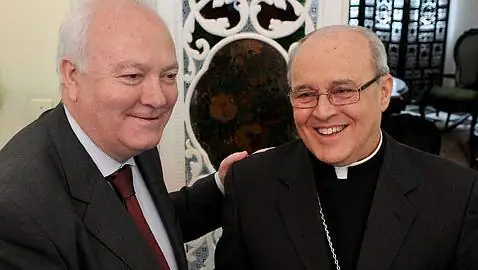
Moratinos con el cardenal arzobispo de la Habana
El cardenal hizo estas declaraciones a periodistas tras reunirse en el Arzobispado de La Habana con el ministro español, que se encuentra en Cuba para apoyar el diálogo abierto entre la Iglesia católica y el Gobierno de Raúl Castro sobre los presos políticos. Jaime Ortega agradeció al ministro español su postura de "comunicación y puente" con Cuba, así como su esfuerzo para tratar de normalizar las relaciones con la Unión Europea, regidas desde 1996 por la llamada "posición común", que las condiciona a avances en materia de derechos humanos. "Se lo agradezco como cubano, como arzobispo de La Habana y como miembro de esta Iglesia que ha tenido esta oportunidad especial de llevar adelante un momento muy propicio para poder dar algunos pasos positivos en el mejor sentido de nuestra situación nacional", declaró el religioso. Por su parte, Moratinos manifestó que el Gobierno español se siente "muy satisfecho" de la labor de la Iglesia cubana en su diálogo con las autoridades de la isla. "Esperamos lógicamente que ese trabajo dé resultados", dijo el jefe de la diplomacia española, quien garantizó que el Gobierno de España "está acompañando todas las actividades y actuaciones del cardenal Ortega y la Iglesia Católica". Tras su encuentro con Ortega, que duró cerca de una hora y media, el ministro español eludió pronunciarse sobre la posibilidad de que España acoja a presos políticos cubanos en el caso de que se produzcan excarcelaciones, al ser preguntado por la prensa. "Vamos a seguir trabajando, vamos a seguir dialogando y eso es lo que tenemos que hacer", manifestó. La visita de Moratinos a Cuba ha aumentado las expectativas de que el Gobierno del general Raúl Castro libere a presos políticos, en el marco del proceso de diálogo abierto con la jerarquía católica el pasado mes de mayo. Fruto de esas conversaciones, el régimen cubano excarceló en junio a un preso gravemente enfermo, Ariel Sigler, y "acercó" a doce a centros penitenciarios ubicados en sus provincias de residencia. Además de con Ortega, el jefe de la diplomacia española se reunió este martes con el canciller cubano, Bruno Rodríguez, con quien repasó el estado de las relaciones bilaterales entre ambos países. Ambos coincidieron en que el momento de esta visita -la tercera de Moratinos a Cuba- se produce en un momento "importante" y "promisorio" y se mostraron convencidos del éxito de la misma.
Subscribe to:
Posts (Atom)